

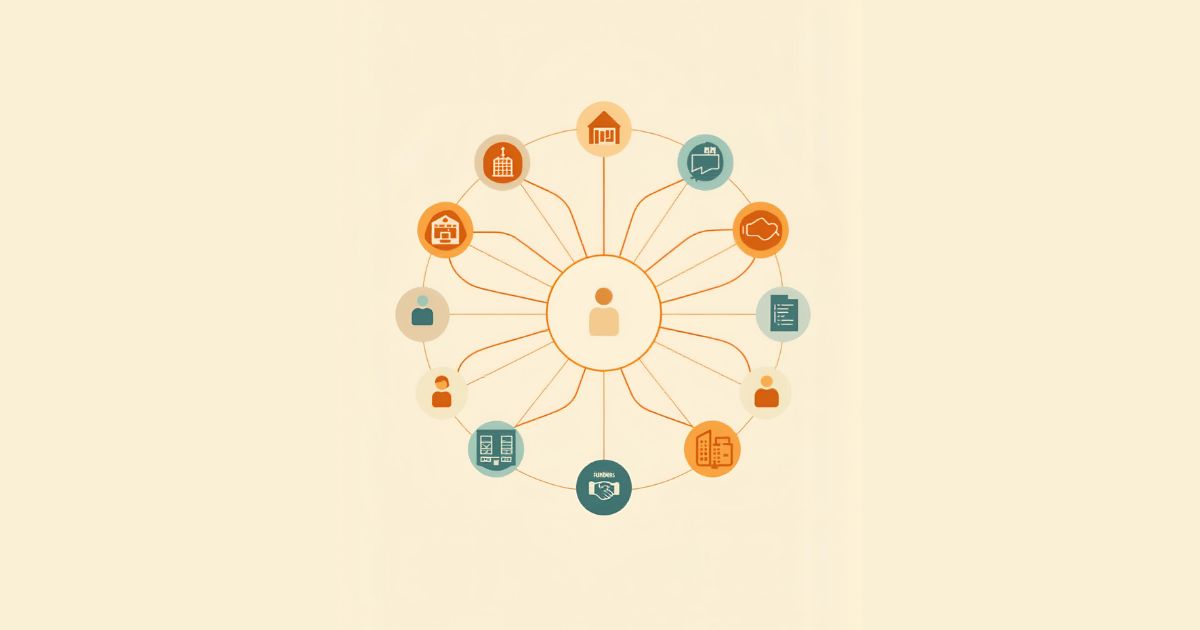
You track more relationships than most salespeople do — but none of what you're doing looks like a sales pipeline. You're following a small business owner through their first year, logging the advice your advisor gave them in February, connecting them with a grant program in April, and reporting to a funder about their revenue growth in October. You're building an ecosystem, not closing deals.
So when someone suggests you just use Salesforce or HubSpot to manage it all, you already know how that ends: six months of customization, workarounds that break when the platform updates, and eventually, back to spreadsheets.
What economic developers and ESOs actually need is a CRM designed around how economic development programs work. This guide walks through what that looks like — and why it matters for the organizations you serve and the funders who support your work.
Why Standard CRMs Don't Fit Economic Development Work
A sales CRM has one job: move a contact from "prospect" to "closed." Every feature — pipeline stages, deal values, win rates — is built around that linear journey. Economic development is almost nothing like that.
Your work is relational, longitudinal, and impact-driven. A business you support today might not show measurable outcomes until next year. The "deal" is never closed — it's an ongoing relationship. And your success metric isn't revenue won; it's jobs created, businesses stabilized, and communities strengthened.
When program managers try to adapt a sales CRM to this reality, three things consistently break down:
Reporting doesn't map to funder requirements. Funders want to know how many businesses you served, what technical assistance you delivered, and what economic outcomes you can attribute to your program. Sales dashboards don't produce any of that automatically. You end up exporting data and reformatting it manually — every single quarter.
Cohort and program logic is missing. Economic development programs run in cohorts, serve distinct populations, and track participants through multi-stage journeys. Generic CRMs treat everyone the same: as a contact in a pipeline stage. There's no concept of a cohort, a technical assistance session, or a milestone framework.
Grant compliance becomes a scramble. Many ESOs and economic development organizations are grant-funded. That means documentation requirements: TA hours logged by service type, participant demographics, outcome data at 6 and 12 months. A CRM that wasn't built for this makes compliance documentation a manual, time-consuming process — exactly when you can afford it least.
What an ESO CRM Should Actually Do
The right CRM for economic development work should feel like it was designed for the way you already work — not like something you're forcing to fit.
Track every participant across their full journey
Your CRM should hold a complete record for each business you support: intake information, demographics, milestone progress, TA sessions logged, resources connected, and outcome data over time. Not just contact fields — a full program record. When a new team member joins, they should be able to open any record and understand the full history in minutes.
Log technical assistance without the friction
TA documentation is one of the most compliance-critical tasks in economic development — and one of the most painful to do in a tool that wasn't built for it. Your CRM should make TA logging fast and specific: who was served, what type of service was delivered, how long it took, and what the outcome was. This data should aggregate automatically into the reports your funders need.
Report on economic impact, not sales metrics
When your ED board or funder asks about program outcomes, you should be able to answer with data in hand — not estimates. Jobs created, businesses retained, capital connected, milestones completed. An economic development CRM should surface these numbers from the data your team already logs, so impact reporting is a byproduct of doing the work, not an additional burden.
Support a network of partners, mentors, and resources
Economic development isn't one organization — it's an ecosystem. Your CRM should let you map your network: the SBDC partners, the mentors, the lenders, the technical service providers. When a participant needs a specific kind of help, you should be able to connect them quickly, and log that connection as part of their record.
Handle grant tracking alongside participant tracking
Many economic developers manage grant programs in addition to service delivery. Your CRM should let you track which participants are part of which grant-funded program, log the specific activities required for each grant, and generate reports aligned to funder reporting templates — without building custom spreadsheets every time.
How Catalyzer Approaches Economic Development CRM
Catalyzer is a free CRM built specifically for small business support organizations — economic development agencies, ESOs, SBDCs, incubators, accelerators, and nonprofits running entrepreneur support programs.
It's not a sales CRM with new labels. The architecture was designed around the workflows economic developers actually use.
One place for all your program data. Every participant record, TA log, milestone, cohort, and referral lives in Catalyzer. When a funder calls with a question, the answer is already there. When a team member leaves and someone new comes in, nothing is lost.
Impact reporting that builds itself. Catalyzer's dashboards pull from the data your team logs in real time. Hours of technical assistance by service type, milestone completion by cohort, economic outcomes by program — these aren't reports you have to build. They're reports you read, because the documentation happened as part of the work.
Purpose-built, not repurposed. The organizations using Catalyzer collectively support more than 25,000 small businesses across 200+ communities. EIC built Catalyzer specifically for this audience — not adapted from a sales tool, not duct-taped together from generic software. The platform reflects how economic development programs actually operate.
Free for ESOs and economic development organizations. Catalyzer's free CRM is a full-featured platform, not a stripped-down trial. EIC's mission is to equip organizations doing this work — not to charge nonprofits and government agencies for tools they need to serve their communities.
Three Signs You've Outgrown Your Current System
If any of these sound familiar, it's time to look at purpose-built economic development CRM software:
You spend more than a few hours preparing a funder report. If pulling quarterly impact data takes more than an afternoon — or requires tracking down information from multiple people — your current system is working against you.
Your program knowledge lives in one person's head. When staff turnover means losing context about participant relationships, milestone history, or TA logs, you don't have a data management system. You have institutional memory waiting to walk out the door.
You're rebuilding tracking systems for every new cohort. If each new program cycle means duplicating spreadsheets, reformatting templates, or re-explaining the system to your team, you're paying a recurring tax on tools that should have solved this once.
Start Where You Are
The best time to move your program data into a purpose-built system is before your next reporting deadline — not after. Catalyzer is free for economic development organizations and ESOs, with no trial period and no credit card required.
Get started with Catalyzer and see how economic developers at 200+ communities have replaced spreadsheet chaos with real-time program visibility.
Catalyzer is a product of Economic Impact Catalyst (EIC), whose mission is to equip organizations that support entrepreneurs with the technology and data they need to succeed. EIC supports 100+ organizations and 25,000+ businesses across the United States.

.jpg)