

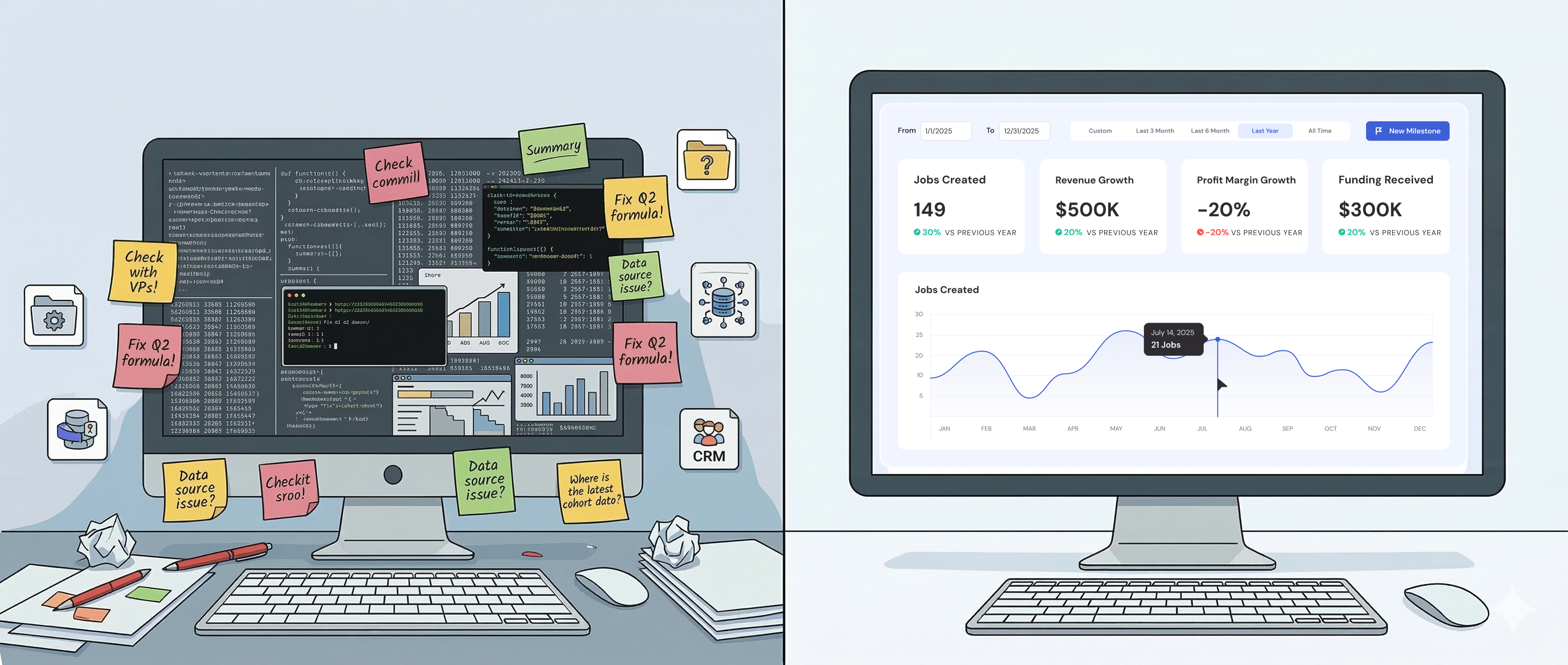

Before COVID, when I was a program manager, the idea of adding a CRM surfaced more than once. We knew our spreadsheets were fragmented. We knew reporting was heavier than it should be.
As we added programs, it became increasingly tedious to connect data across them. Entrepreneurs who participated in multiple offerings appeared differently in each spreadsheet. Fields weren’t standardized. Some programs tracked revenue growth. Others didn’t. Some captured demographic data in detail. Others asked just the basics.
When we eventually decided to implement a CRM, we ran into a much bigger problem: the data was not structured consistently enough to import cleanly. Fields didn’t match. Definitions weren’t aligned. Historical information had gaps. What should have been a straightforward migration became a painful reconstruction project that was never quite figured out.
At the time, I assumed this was unique to us as a new nonprofit.
Later, when I began coaching ESOs on program management, I saw this wasn’t unusual. Many organizations — even established ones — didn’t have a formalized system for tracking the entrepreneurs they served or the outcomes of their programs. Intake lived in one tool. Event registrations lived in another. Mentor notes lived somewhere else. Reporting meant stitching everything together at the last minute.
That model worked, but it created a lot of unnecessary friction. And at the time, it felt like the only realistic option. If you were a new or small ESO, you either relied on affordable, disconnected tools that weren’t designed for entrepreneur support work, or you considered expensive enterprise systems built for other industries.
In other words, you had to choose between affordability and unified infrastructure. For most of us, affordability won — and we absorbed the operational cost later.
Today, that tradeoff no longer has to define your launch strategy. The real question isn’t just when to add a CRM. It’s whether new and small ESOs still need to choose between affordability and structure at all.
The Traditional “Lean Stack” — And Its Limits
For years, new and small ESOs have relied on a collection of low-cost tools:
- Google Forms or Typeform for intake
- Airtable for tracking
- Eventbrite or Luma for events
- Asana or Trello for task management
- Google Sheets or Excel to reconcile everything
These tools are powerful. They are flexible. And they are affordable.
But they are disconnected by default.
They were not built specifically for entrepreneur support work. They do not naturally connect intake to program participation to mentor engagement to outcome tracking. That integration has to be built manually — through spreadsheets, exports, APIs, or automation tools like Zapier.
In the early days, that tradeoff made sense. High effort in exchange for low cost.
But that tradeoff is no longer necessary.
The Old Assumption: Low Cost = High Manual Effort
Historically, ESOs had two choices:
- Stay scrappy with free tools and accept heavy manual reconciliation.
- Invest in expensive enterprise software built primarily for other industries and adapt it.
That forced new and small organizations into operational compromise. You could save money, but you would pay in staff time and reporting stress.
The problem is not that Google Forms or Airtable are bad tools. The problem is that they were not designed around the lifecycle of entrepreneur support:
- Intake
- Program enrollment
- Cohort participation
- Mentor matching
- Activity tracking
- Longitudinal outcomes
- Impact reporting
When you piece together generic tools, your staff becomes the system architect.
What’s Different Now
With the introduction of Catalyzer, new and small ESOs no longer need to choose between affordability and structure.
Catalyzer can be used at a free or low per-seat cost while still providing:
- A built-in CRM
- Centralized entrepreneur profiles
- Structured intake
- Program tracking
- Mentor management
- Reporting aligned to impact
From the beginning, you can operate within a unified system designed specifically for entrepreneur support work — without jumping immediately to enterprise pricing.
This changes the decision framework.
You no longer have to wait until chaos forces you into a system upgrade. You can start structured.
So When Should You Add a CRM?
If you are:
- Tracking entrepreneurs across programs
- Managing more than one cohort
- Reporting to funders
- Coordinating mentors
- Or spending hours reconciling spreadsheets
You are already doing CRM work. You are just doing it manually.
The question is not whether you need a CRM. It’s whether you want your team to function as one.
For brand-new ESOs or independent providers, traditional tools may still technically work. But the cost is discipline, time, and ongoing manual integration. With Catalyzer available at no or low cost, that tradeoff becomes harder to justify.
The Strategic Advantage of Starting Structured
Starting with a unified system does more than save time. It:
- Standardizes your intake from day one
- Preserves clean historical data
- Makes reporting routine instead of reactive
- Reduces internal friction
- Builds credibility with funders
Spreadsheets are not inherently wrong. But they scale poorly.
If your mission is long-term impact, your infrastructure should reflect that from the start — not after things break.
The Bottom Line
In the past, ESOs had to tolerate fragmented systems until they could afford something better. That constraint shaped behavior across the sector.
That constraint no longer exists.
You can still assemble a stack of generic tools and manage the integration yourself. Or you can use a system built specifically for entrepreneur support — at a price point accessible to new and growing organizations.
The difference is not just convenience. It is operational maturity from day one.

.jpg)